
Living alone doesn’t require a house full of specialized products. But it does reveal how many everyday things are designed around the assumption that more than one person lives there.
Sometimes the problem isn’t the product itself. It’s the size, the quantity, or the expectation that someone else will be around to help.
A few small adjustments have made a surprising difference in my everyday life.
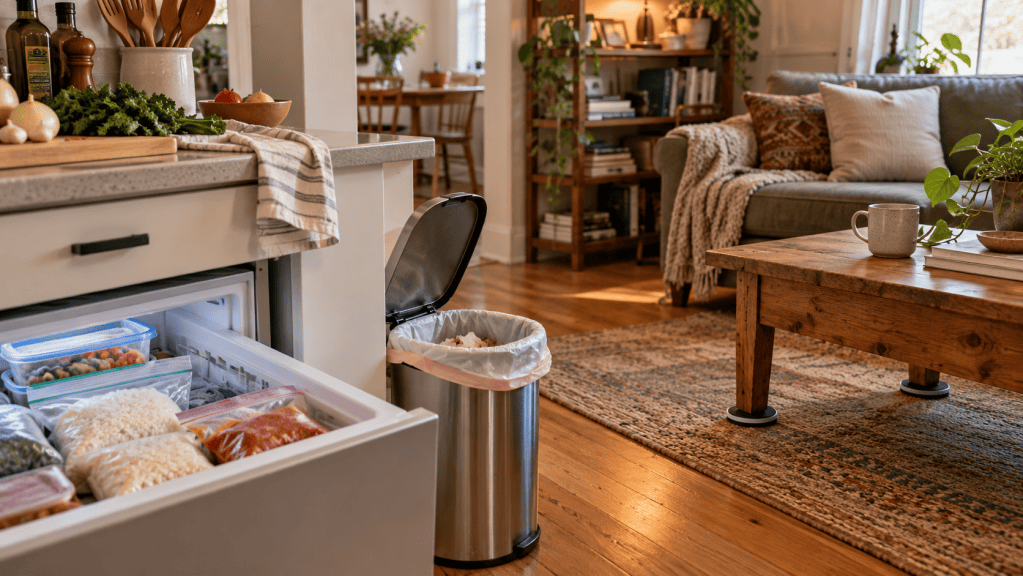
The garbage bag that’s too big
Here’s an annoyance that rarely gets discussed: what do you do when your kitchen garbage starts to smell long before the bag is full?
A standard kitchen garbage bag can take quite a while to fill when you’re living alone. You feel wasteful throwing away a nearly empty liner, so you leave it another day. Meanwhile, whatever’s inside has other plans.
My solution was hardly revolutionary. Smaller bags.
I often reuse grocery bags as garbage liners. They fill up sooner, and I can take them out more frequently without feeling like I’m wasting a large bag. For anything wet or likely to leak, a sturdier small liner makes more sense.
No elaborate odor-control system or expensive trash can required.
Sometimes the answer is simply a smaller container.
A freezer full of possibilities
Cooking for one has its advantages, but making a single portion of everything isn’t always practical. A pot of spaghetti sauce takes roughly the same effort whether you’re making one serving or several.
So I freeze individual portions.
Rice, spaghetti sauce, and other staples go into the freezer in quantities I can actually use. Over time, they become a small inventory of ready-to-use ingredients and meals.
It’s different from traditional meal prep, where you cook five identical lunches and spend the week eating them. I like having options. One evening I might pull out some sauce, another day some rice. When I don’t feel like cooking, there’s usually something available.
Silicone freezer trays are useful for portioning, especially liquids and sauces. But ordinary freezer bags work perfectly well for many things, too. I often use sandwich-size zip bags.
Just cool cooked food promptly and refrigerate it before transferring it into bags that aren’t intended for hot food. Rice in particular needs careful cooling and storage.
You don’t necessarily need an expensive storage system. The real benefit comes from freezing food in quantities you’ll actually want to eat.
Furniture sliders: a second pair of hands, almost
Then there’s the occasional need to move something heavy.
A coffee table looks perfectly manageable until you decide it belongs on the other side of the room. Without someone to help lift it, even a simple rearrangement becomes a production.
Furniture sliders are one of my favorite inexpensive household tools. Slip them beneath the furniture legs, and pieces that would be difficult to lift can often glide across the floor with much less effort.
Of course, the sliders need to be appropriate for the flooring, and they’re no substitute for help when something is too heavy or unstable to move safely.
But for an ordinary coffee table or other manageable piece of furniture, they’re wonderfully effective.
I wish I’d discovered them sooner.
Buy less, solve more
What these solutions have in common isn’t sophisticated technology or clever marketing. They’re ordinary ways of making household tasks better suited to how you actually live.
A smaller garbage bag. A freezer organized around individual portions. A few furniture sliders tucked away until they’re needed.
None requires a major investment. In some cases, you don’t need to buy anything at all.
Before purchasing another product advertised as ideal for one person, it’s worth looking at what you already have.
Sometimes it just needs to be used differently.

